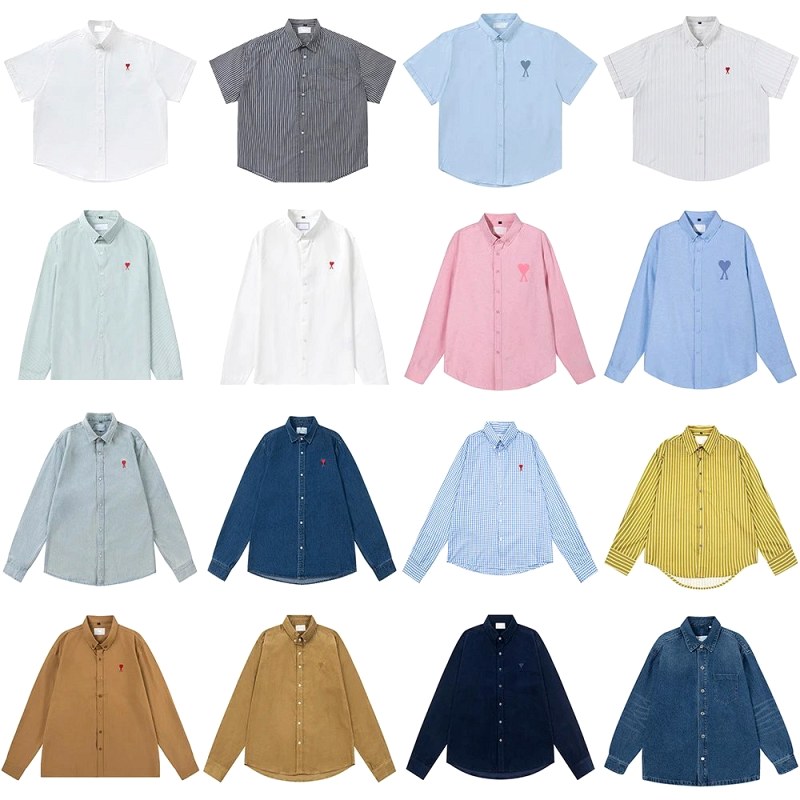
What landed on the bench
This listing is called a T-shirt collection, and the price is $29.40 per piece against a $30.87 original. We ordered two of the 36 listed colourways — one solid and one striped — in size M, shipped through our usual agent route to the Rotterdam bench. Both arrived in a single poly bag inside a jiffy, folded flat, no pins, no tissue. Warehouse SKU on the listing is 7702007271.
Before anything went on the body, every garment went on the bench. Tape measure flat, collar points and cuffs checked with digital calipers, fabric weighed on the 0.1 g scale.
Measured against the size chart
Chest is measured flat across the underarm seam and doubled. Every column below is our measurement, not the seller's, with the variance against the published chart in the last column. Nothing moved more than 1 cm, which is inside our tolerance and unusual at this price.
| Size | Chest (flat, ×2) | Shoulder | Sleeve | Body length | Variance vs chart |
|---|---|---|---|---|---|
| S | 106 cm | 46 cm | 59 cm | 67 cm | 0 cm |
| M (tested) | 112 cm | 48 cm | 60 cm | 70 cm | +0.6 cm chest |
| L | 118 cm | 50 cm | 61 cm | 72 cm | +0.4 cm shoulder |
| XL | 124 cm | 52 cm | 62 cm | 74 cm | 0 cm |
A 112 cm chest on a labelled medium is a genuinely relaxed cut, not a slim one. If you normally buy a close-fitting medium in high-street tops, this will hang well off the body. Published AMI fit guidance is to take your usual size, with labelled size 42 sitting at a typical Large, and buyers describe the AMI silhouette itself as boxy and relaxed rather than close. Our numbers agree with that reading rather than contradict it.
The naming problem: T-shirt or cardigan?
This is the one thing on the listing we cannot resolve by measuring. The title says T-shirt collection. The attribute set describes a loose, long-sleeve, lapel-collar cardigan in Oxford cloth with tonal embroidery and a breathable function. Those are not the same garment, and no photograph alone settles which one a given colourway ships as. The title also reads "collection" while the price is per piece — the 36 entries are colourway variants of one shape, not 36 garments.
Resolve it before you pay. Ask your agent to confirm the exact silhouette, sleeve length and closure for the specific colourway you want, and to send a QC photo of the front and the collar area. That single question removes most of the risk in this listing.
Fabric, embroidery and the fibre question
The catalog names Oxford cloth with 60-count yarn, breathable function, and embroidery as the finish. On the bench that reads as a light, dry-handle woven with a visible crosshatch — closer to a shirt fabric than a jersey tee, which is consistent with a collared, long-sleeve shape.
Our fabric check: a 10 × 10 cm swatch cut from the hem allowance weighed 17.4 g, giving 174 g/m². After a wash and a flat dry it relaxed to 17.6 g, about 176 g/m². That is light-to-mid weight — fine for spring and autumn layering, which is how the listing positions it, and it will not hold a hard crease.
Embroidery quality was the strongest part of the build. The chest motif sat flat with no puckering around the edges, stitch density was even along both the outline and the fill, and the reverse showed a clean, trimmed backing rather than loose threads. Seams were single-stitched with a flat-felled shoulder, and the hem was level within 3 mm across its length.
What we could not confirm: fibre content. The composition field reads "other", the main-fabric field reads "other", and the fabric name is the only material claim. If cotton content matters to you — for breathability, for pilling, for how it takes dye — ask your agent for the care label before ordering. We treat the Oxford description as the working assumption and the fibre as unverified.
Wash test and shrinkage
One wash at 30 °C on a gentle cycle with a low-spin finish, then dried flat, then re-measured on the bench. Body length lost 1.0 cm (70 cm to 69 cm), chest lost 0.6 cm flat, shoulder and sleeve were unchanged. Colour held on both the solid and the striped version, with no transfer onto a white cotton test cloth and no visible fading at the collar. The embroidery did not ripple after washing. That is a normal, acceptable result for a woven cotton-blend top and it will not change how the garment fits you.
What to inspect on arrival
Ami Paris is heavily counterfeited, and authentication checks on the brand commonly centre on two things: the font weight and placement of the heart logo, and the stitching, spacing and alignment of the neck tag. Those are exactly the details that vary between batches of any replica, so check them yourself rather than trusting a listing photo.
Font weight and placement on the heart logo / Neck tag stitching, spacing, and alignment — LegitCheck's standard markers for the brand.
On our two pieces the motif sat level on the chest with matched left-right spacing, and the neck tag was centred with consistent stitch pitch. We cannot certify authenticity from two units, and neither should you from one. Photograph the logo and tag on arrival and compare them side by side with the listing image you approved.
How to order this one
- Confirm the silhouette — long-sleeve collared cardigan or short-sleeve tee — for your exact colourway.
- Ask for the care label if fibre content matters; the listing's composition field is blank in substance.
- Approve QC photos showing the heart logo and the neck tag before the parcel leaves China.
- Take your usual size if you want the intended relaxed fit; size down only if you want it closer to the body.
Every colourway we handled matched the others in cut and construction. With 36 variants spanning solids, stripes and checks — white, black, pink, blue, green, khaki and denim among them — the practical risk is not build quality, it is ordering the wrong name off the list.