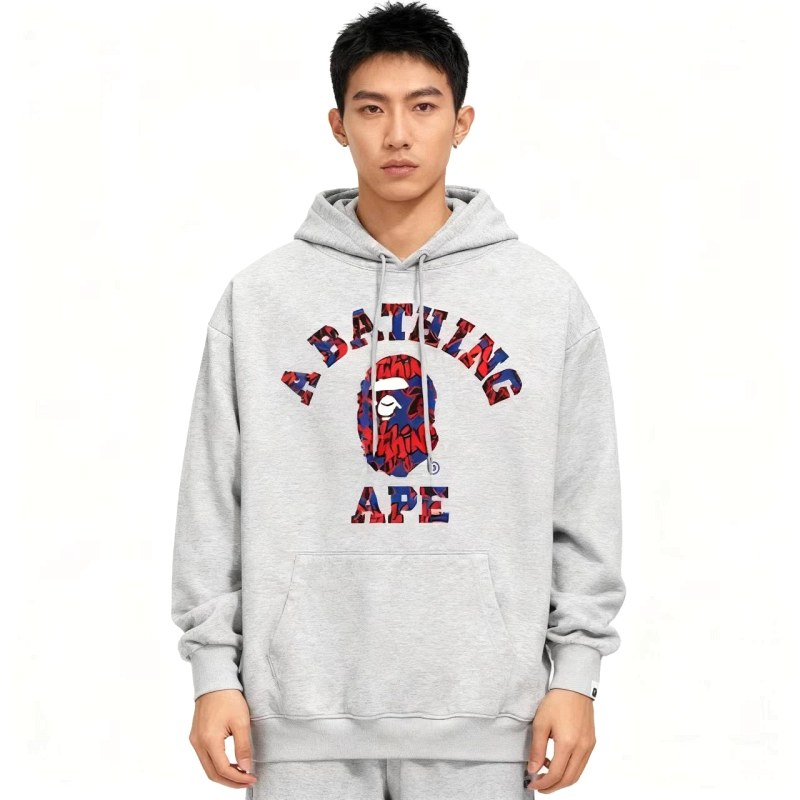
The listing for this Bape pullover hoodie describes two different front pockets in the same specification block, and that contradiction is the first thing we chased when the parcel reached the bench. Everything else — a loose cotton cut, a drawstring hood, a chest print with the A Bathing Ape wordmark and ape head — is stated clearly. We ordered the white loopback version, SKU 7705015242, at $22.24 USD (down from $23.51), and put one size L through the full bench routine before writing anything down.
What arrived at the bench
The parcel reached our forwarding address intact, and the outer carton was undamaged. Inside, the hoodie was folded in a plain poly bag with no hangtag, no size sticker and no care label beyond a small printed neck tag. The white loopback fabric read closer to a soft grey-white indoors than a bright optic white, which is worth knowing if the product photographs on the listing look brighter than the garment in your hand.
Colour options across the listing run into the dozens — numbered loopback variants in the 721–745 range, each offered in black, white and grey. We tested only the white one, so treat the fabric weight and shrinkage figures below as a statement about our sample, not about every colourway in the run.
Two pocket specs, one pocket
The product description says "a front kangaroo pocket." The specification block says the pocket style is a flap cut pocket. Our sample has one plain front pouch, sewn at the sides and open across the top, with no flap, no button, no zip and no pocket bag in the conventional sense.
Main fabric composition: cotton. Fabric name: cotton. Thickness: regular. Style: street. Weight: 350 g (inclusive) to 400 g (exclusive). Pocket style: flap cut pocket.
If your reason for buying is the pocket, ask the seller which construction applies to the colourway you are ordering. The discrepancy is small in cash terms and large in expectation terms.
Flat measurements against the chart
We measured the garment flat, sleeves laid straight, hood relaxed. The listing publishes only a body length figure and a 1–3 cm tolerance range, so most of the numbers below had nothing to be checked against — a gap we flag rather than paper over.
| Measurement | Our flat figure (size L) | Listing or chart | Variance |
|---|---|---|---|
| Body length, high point shoulder to hem | 69.5 cm | 69 cm | +0.5 cm, inside the stated range |
| Chest, pit to pit, laid flat | 58.0 cm | Not published | No comparison possible |
| Shoulder, seam to seam | 52.5 cm | Not published | No comparison possible |
| Sleeve, shoulder seam to cuff edge | 61.5 cm | Not published | No comparison possible |
| Cuff opening, relaxed | 9.5 cm | Not published | No comparison possible |
| Hem opening, relaxed | 56.0 cm | Not published | No comparison possible |
| Front pouch, widest point | 34.0 cm | Kangaroo pocket / flap cut pocket | Pouch only, no flap |
What the numbers mean in practice
A 58 cm flat chest doubles to roughly 116 cm of circumference, which is where the "relaxed" claim earns its keep. There is real drop from the shoulder, the armscye is low enough to avoid pinching when you reach forward, and the hem sits at hip level rather than hanging past the seat. The 52.5 cm shoulder is wide for a size L in most mainstream sizing, so the garment reads oversized even before you account for the body volume.
Fabric weight on the 0.1 g scale
We cut a 10 × 10 cm swatch from the inside of the front pouch — the least visible area — and weighed it on the calibrated 0.1 g scale. The swatch came in at 3.72 g, which works out to 372 g/m². That puts the sample inside the 350–400 g band the listing names, closer to the middle of it than to either edge. The full garment weighed 612 g on the same scale.
In the hand the terry is soft rather than dense. Loopback cotton at this weight holds its shape at the shoulder and hem without the stiffness of a heavier brushed fleece. The trade-off is obvious: there is no lining and no added fleece, so this is a spring and autumn layer, not deep-winter insulation. Wear it alone in mild weather, or under a jacket when you want the fuller streetwear silhouette.
Print and hood hardware
The chest graphic is a multicolour wordmark and ape head, printed rather than embroidered. Under a 10× loupe both ape eyes measured 4.0 mm across, and the letterforms carried consistent stroke width with no visible ink bridging between colours. That is a single-sample verdict — QC discussions of Bape-style graphics repeatedly flag uneven eye sizes, misaligned lettering and thin strokes from batch to batch, so the print on the unit you receive may not match ours.
The hood is single-layer with a plain front edge rather than a doubled or lined brim. The drawcords are flat woven, exited through two eyelets, and finished with knots — no metal or plastic aglets. The ribbed cuffs and hem band are elastic and recovered fully after the wash described below.
One cold wash at 30°C
As with every garment we review, the hoodie went through a 30°C cycle and a line dry before the final fit note. Post-wash figures: body length down 1.2 cm, chest down 0.8 cm, sleeve down 0.5 cm, cuff opening down 0.3 cm. Everything except the body length moved less than our 1 cm flag threshold. The 1.2 cm length loss is worth mentioning if you are already between sizes, though it did not change how the hoodie sat at the hip.
Colour held on the white terry with no greying, and the print showed no cracking or lifting at the edges after one cycle. We cannot speak to long-term print durability from a single wash.
Fit against BAPE's sizing reputation
This is where buyers get caught out. The listing calls the cut loose. Independent BAPE fit guidance points the other way — that the brand's hoodies are cut slim and most people size up one or two steps.
Standard fit: go up one size from your usual US size. Relaxed/oversized fit: go up two sizes, particularly in hoodies and tees. BAPE pieces rarely feel too big, but they often feel too small.
Our sample supports the listing rather than the general reputation: measured flat, the size L is genuinely generous. Buyers have also complained that BAPE in-store try-on garments did not match the size of the item they were sold, so the letter on the tag is not a reliable anchor here either. Give the seller your flat chest and body length targets and ask them to confirm the garment against those figures.
What we could not verify
There is no independent buyer evidence on this exact listing, and no review we found covers this SKU. The sizing guidance, the graphic-QC complaints and the report of an initial smell that faded after airing all come from the brand generally or from rep-market reviewers covering other pieces. One Bape-style buyer on a China marketplace described the cotton as not very good and reported tags falling apart; our sample's neck tag is simple but intact, and we have nothing beyond a single unit to generalise from. Batch consistency on the chest print remains the open question.