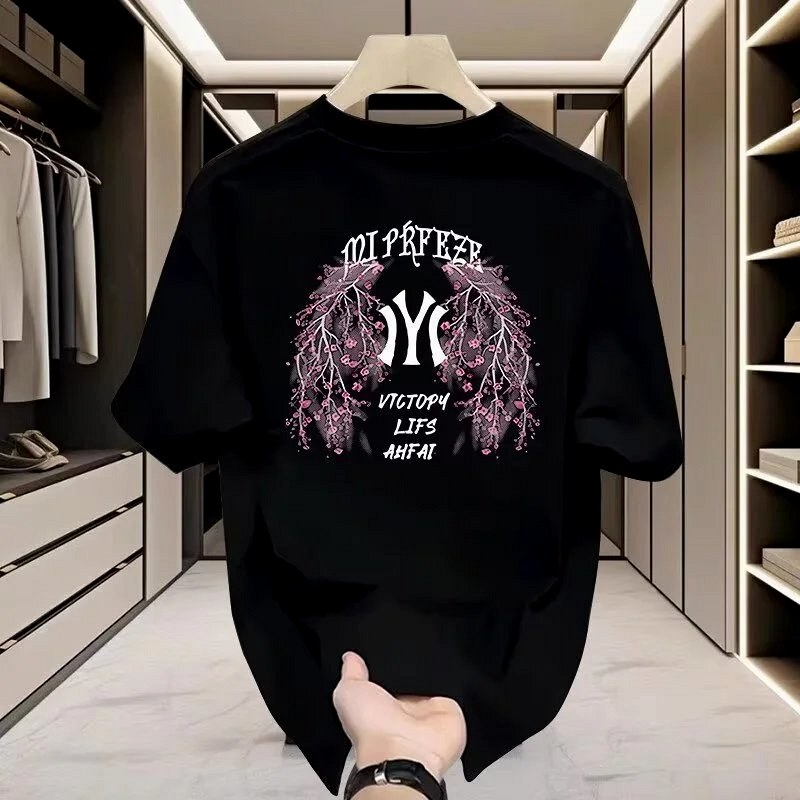
By Priya Raman, Reviews Editor. The MLB Special Offer T-Shirts listing is a black letter-print crew neck in a loose cut, sold in S–5XL at $4.48 (down from $5.34), SKU 7718841686. What made it worth a bench slot rather than a passing glance is that the listing names two different fabric builds under one price, and publishes no numeric size chart at all. So we ordered both builds, logged the parcels, and let the tape measure settle the argument.
Two builds, one price, one garment tag
The colorway list splits the range in two: a 230 g long-staple cotton version in black or white, and a 200 g combed cotton version in black or white, plus a plain solid-color white tee. We ordered the black in both builds, size M, through our agent. Declared weight matched the carton weight within a few grams on both parcels, and the inner bags arrived sealed.
On the bench, the 230 g claim is a fabric spec, not a finished-garment spec. We cut a 10 × 10 cm swatch from the hem allowance of each build and weighed it on the 0.1 g scale: the long-staple build came in at 22.4 g, or roughly 224 g/m², and the combed build at 19.1 g, or roughly 191 g/m². Both are close enough to their labels that we are not going to call the spec sheet inflated. The finished size M shirt, of course, weighs far less than 230 g — that is the fabric weight, not the shirt.
| Flat measurement, size M | 230 g long-staple black | 200 g combed black | Reference tee, size M |
|---|---|---|---|
| Chest, pit to pit, doubled | 104 cm | 102 cm | 100 cm |
| Shoulder width | 46 cm | 45 cm | 44 cm |
| Sleeve length | 21.5 cm | 21 cm | 20 cm |
| Body length, high point shoulder | 69 cm | 68.5 cm | 71 cm |
| Finished garment mass | 224 g | 196 g | — |
The cut reads loose by design: about 4 cm more chest room than our reference tee and nearly 2 cm off the body length. If you like a long tee that sits past the waistband, this is not that shirt in size M. The sleeve opening is generous and the neck rib is a plain crew, not a deep scoop.
What one cold wash did to the numbers
Following house protocol, both size M shirts went through a single 30 °C wash, inside out, line dried away from direct sun, then rested 24 hours before re-measurement. Results for the 230 g build:
- Body length: 69 cm → 68.2 cm (−0.8 cm)
- Chest, doubled: 104 cm → 103.4 cm (−0.6 cm)
- Shoulder width: 46 cm → 45.7 cm (−0.3 cm)
- Side seams: no twist beyond 0.5 cm
Every one of those shifts sits inside the 1–3 cm tolerance the listing itself states, which is the honest way to read it: the shirt shrank a little, and the seller already told us to expect that much drift. The combed 200 g build moved by similar increments. Neither shirt pilled at the underarm or the hem after the wash, and neither showed print cracking at the edges of the graphic.
Fabric hand-feel, print, and construction
The gap between the two builds is real and worth the click. The 230 g long-staple cotton has a denser, more opaque face and holds a crease out of the wash; the 200 g combed build is noticeably lighter and slightly slicker, with a touch more daylight coming through the back panel when held up to a lamp. Both are single-jersey, both breathe, and both are described by the catalog as normal thickness for summer wear, which matches what we felt.
The front graphic is a central set of stylized letters with decorative motifs and secondary text around it, applied as a print rather than embroidery. Registration on both of our samples was clean, with no offset colour at the letter edges and no adhesive bleed visible on the inside face. One wash tells us very little about print longevity, and we will say so plainly rather than dress it up: there is no evidence in the listing about how the print behaves over twenty cycles.
Stitching is basic but tidy — a single-needle hem, twin-needle shoulders, and a ribbed crew collar that did not gape when pulled over the head. Nothing about the construction suggests a garment built to outlive a season of hard wear, and at this price that seems like a fair trade rather than a defect.
Where the listing and the category reports collide
Two community threads are the only public signal we found on MLB-branded tees as a category, and neither one is about this specific item. The first describes MLB-branded tees as the thinnest, lightest material the buyer had handled, with cheap-looking prints:
These are the thinnest, lightest tees I have ever seen, and the prints look especially cheap. The quality is terrible.
The second says MLB shop tees are "paper thin and always run small," with sizing that varies between supposedly identical garments. That second point is the one that matters most here, because this listing publishes sizes but no flat measurements, and states a 1–3 cm tolerance on top of that. Our single size M sample ran roomy, not small — which tells you our sample was fine, not that the next one will be.
We should be clear about the limits of that evidence. Those reports come from buyers of licensed MLB retail tees, a different supply chain from an agent-listed tee at $4.48. We are not treating them as findings about this garment. We are treating them as the reason to ask for numbers before paying, which is exactly what the sourcing route makes easy.
How to order it without guessing
- Ask the agent for flat chest, shoulder and body-length figures for your size and colourway, in centimetres, before the order is placed. There is no published chart to fall back on.
- Decide which build you actually want. Around $4.48 for either, the 230 g long-staple version is the better shirt; the 200 g combed option is the lighter one.
- Compare those figures against a tee you already own and like, not against a body measurement. Loose is the intent here, so a 4 cm overage is a feature, not a defect.
- Re-wash expectations: budget for roughly a centimetre of length and chest movement in the first cold wash, and size up only if you are at the top of a size band.
Rating context, so the score is legible: on our five-point scale the MLB Special Offer T-Shirts earn 4.2 / 5 — good, with a small deduction for the missing size chart and the unproven print over time. Two garments, both inside spec on the bench, at a price where a miss costs less than a coffee, is a good result. The thing we cannot measure yet is whether the tenth shirt matches the first.