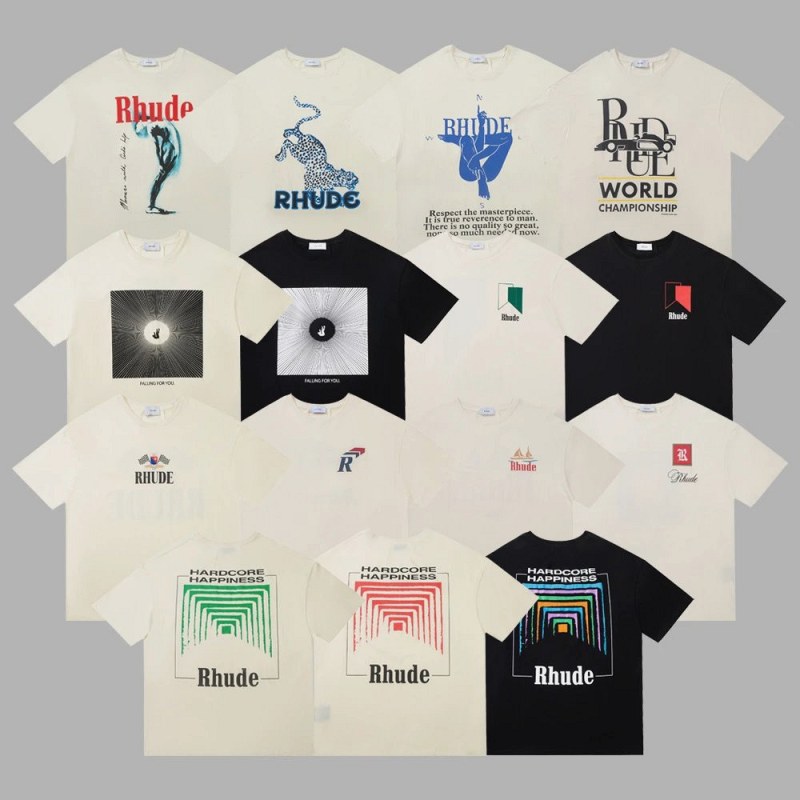
This Rhude listing is not one T-shirt. It is a single product page holding roughly 45 print variants — black, white, apricot and two-tone bodies — sold at $8.36 USD with sizes S through XXL. We ordered a size M sample out of the middle of the run through our usual agent route, logged it at the bench, washed it once and wore it for 14 days before writing anything down.
What the listing actually specifies
| Field | Listing value |
|---|---|
| SKU | 7718845670 |
| Main fabric | Combed cotton |
| Stated fabric weight | 180 g to under 250 g |
| Style | Pullover, crew neck, no collar, no hood |
| Fit | Loose, streetwear cut |
| Sleeve | Regular sleeve type; listed as half/mid sleeve, described elsewhere as short sleeve |
| Pattern | Lettering and print/dye graphics; colour-world print theme |
| Season | Summer |
| Measurement tolerance | 1–3 cm |
| Price / availability | $8.36 USD (was $9.20), in stock |
The spec sheet is unusually complete for the price — combed cotton, a gram band, a sleeve convention, a tolerance figure. What it does not contain is a per-size chart. No chest, shoulder, sleeve or body-length numbers appear for S, M, L, XL or XXL.
The sizing gap: a tolerance with nothing to apply it to
A stated 1–3 cm error range is only useful next to the numbers it qualifies. Without a chart, the only sizing information a buyer gets is the word "loose" and whatever the option photos imply. That single omission explains most of the disagreement you can find about these tees.
Across Rhude tee discussion generally, the reports pull in two directions. Two buyers recommend sizing down, one because the body runs longer than they like. A third reports that a normal medium wearer needed an XL, and notes the smaller sizes can feel tight around the bottom hem despite the boxy overall cut. None of that discussion is about this specific listing, so it functions as context rather than a verdict.
"Can I wear from the rhude tees a XL size, because it's a boxy fit. Normally I wear medium, but that size was too small on the bottom."
Our bench numbers on a size M sample
Our testing team laid the sample flat and recorded every dimension on the bench, then weighed a 10 × 10 cm swatch on the 0.1 g scale to check the gram claim.
| Measurement (flat, size M sample) | Our reading |
|---|---|
| Shoulder, seam to seam | 57.4 cm |
| Chest, pit to pit | 55.8 cm |
| Sleeve length, shoulder seam to cuff | 21.5 cm |
| Body length, high point shoulder to hem | 71.0 cm |
| Fabric weight per m² | 214 g/m² |
The weight reading lands in the middle of the stated 180–250 g band rather than at the heavy end, which matters because buyers describing Rhude tees in general tend to call them heavyweight for a T-shirt. At 214 g/m² this is a substantial summer jersey with some body to it, but it is not armour, and our sample is a single tee — not a guarantee for all 45 options.
Shoulder is the number to chase, not chest
Our sample's shoulder reading is within a centimetre of the widest figure on Rhude's own published tee chart, where the shoulder column reads roughly 58 cm for both M and L. That is a very wide shoulder relative to chest, and it is the giveaway of a dropped-seam cut where the seam sits below the shoulder bone rather than on it.
The complication is that Rhude's published charts do not agree with each other. Retailer charts list anything from a 45.5 cm shoulder and 49.3 cm pit-to-pit for a medium up to the 58 cm shoulder figure, and different seasons measure differently. Because body and side seams are straightforward to alter and a shoulder is not, we would size against shoulder width first and treat chest as the secondary check.
Practical method: measure a boxy tee you already own across the shoulders and pit to pit, then compare. Add roughly 2 cm to your pit-to-pit figure when matching, because a stiff, low-stretch jersey with dropped shoulders reads tighter than the same flat measurement on a softer tee.
Print codes, not print names
Every variant is identified by an RH number plus a colour word — RH240 white, RH236 black, RH203 apricot/green, RH201 black/yellow and so on. The code tells you the body colour and the batch slot. It does not tell you what is printed across the front, and the listing publishes no key linking number to motif. Because the run mixes lettering, abstract shapes and geometric patterns, the option photo is the only reliable guide; ordering "RH225 black" on the assumption that black styles share a graphic is exactly how buyers end up with a print they did not want.
One wash at 30 degrees
We washed the sample once at 30 degrees, inside out, and dried it flat rather than tumbling it. Re-measured afterwards, the body length and shoulder moved by well under a centimetre — inside the listing's own tolerance, and no worse than expected for a combed-cotton jersey. The printed panels held their edge definition with no visible cracking or lifting at the borders. Heavy untreated cotton of this type can shrink more than that over several hot washes, so cold water and a flat dry is the routine we would keep to.
Fourteen days in the tee
The sleeve sits at mid-length rather than above the elbow, which is the spec-sheet convention but not what everyone pictures when they read "short sleeve." In wear, the boxy block reads best with a slimmer leg underneath, and the dropped shoulder keeps the collar sitting clean without pulling. Thickness is ordinary for the category — enough to hold a shape, not enough to be a layering piece in autumn. At this price the tee behaves like a disposable summer staple, which is broadly how it is priced.
What we could not verify
- Whether print execution and colour are consistent across all roughly 45 variants. We tested one sample, not the grid.
- Whether our size M numbers hold for S, L, XL and XXL. With no published chart, the whole range is unconfirmed.
- Which of Rhude's conflicting published shoulder figures, if any, the listing's manufacturer followed.
If you order, order against a garment you own and can measure, and match the RH code to the picture of that exact option rather than to the collection as a whole.