This Time's Decision for Broken Planet Apparel Size Filtering
If you're looking for the right size from fashionreps' Broken Planet product catalog, the real issue isn't "which tool is faster"—it's how to put together brand, style, visible sizes, product links, and pending verification info to make a judgment.
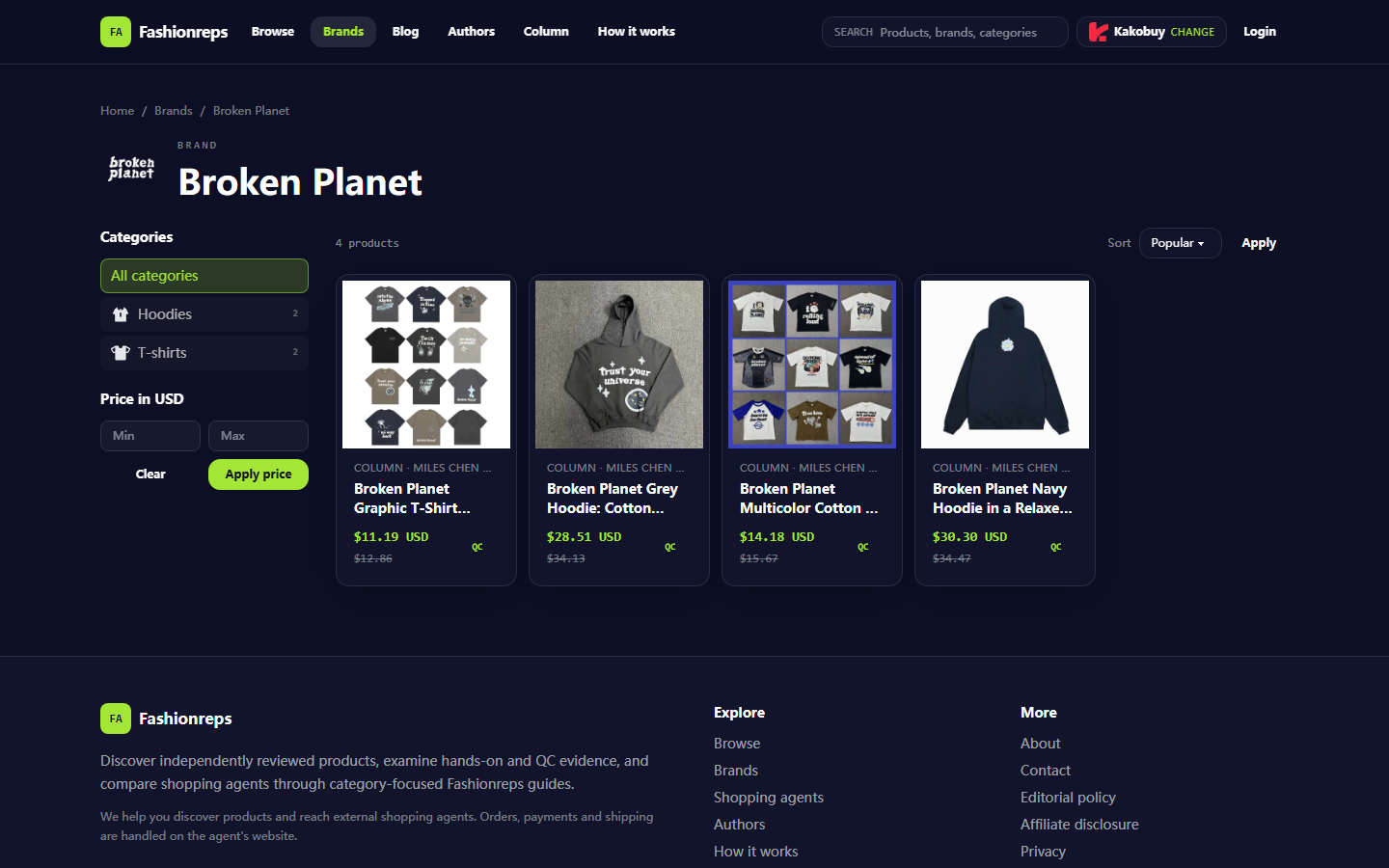
This page currently shows 4 items in the Broken Planet brand catalog, including 2 Hoodies and 2 T-shirts. The page also provides category filters, price range, sorting options, and product cards. Reference prices may change as page records update, so you should note the page display date before filtering and re-check product page info before ordering. 📋
This guide is for those who need to:
- First discover Broken Planet candidate products in the site catalog.
- Then organize candidates by style, size, and price.
- Use Google Sheets to save filter results for later comparison, collaboration, and review.
- Mark products lacking size charts, variant info, or update time as pending verification.
It is not meant to replace product pages, seller pages, or shopping agent pages, and you can't confirm actual stock, fabric feel, fit suitability, or final shipping costs from catalog cards alone.

Image: Broken Planet brand catalog on fashionreps and its visible filter fields.
Confirming Currently Visible Apparel Categories and Product Fields from fashionreps' Site Spreadsheet
fashionreps' Broken Planet brand page currently offers these visible navigation and filter options:
- Brand path: Brands → Broken Planet.
- Product categories: Hoodies, T-shirts.
- Price filter: minimum price and maximum price.
- Sorting: Popular, Latest, Price: low to high, Price: high to low.
- Product card fields: product name, reference price, previous reference price, QC badge, and author info.
- Number of products on page: current catalog page shows 4 products.
Currently visible product names and reference prices are as follows:
| Product | Category | Reference Price Shown on Page |
|---|---|---|
| Broken Planet Graphic T-Shirt Collection in a Loose Cut with Foam-Print Logos | T-shirts | 11.19 USD |
| Broken Planet Grey Hoodie: Cotton Pullover with Foam-Print Lettering in a Relaxed Cut | Hoodies | 28.51 USD |
| Broken Planet Multicolor Cotton T-Shirt with Foam-Print Graphics, S–XL | T-shirts | 14.18 USD |
| Broken Planet Navy Hoodie in a Relaxed, Boxy Cut | Hoodies | 30.30 USD |
These are reference info visible on the catalog page at the time, not to be taken as real-time stock, final price, or complete size chart. The page explicitly shows S–XL for one T-shirt, but whether other products have the same size range requires checking the respective product pages.
The catalog is good for first-round discovery and narrowing down. It helps you group by Hoodies or T-shirts first, then sort by price; but it may not include complete sizes, measurements, stock status, seller response, or return conditions for every variant. 🔎
How to Set Up Brand, Style, Size, and Link Columns in Google Sheets
Google Sheets isn't a replacement for fashionreps' product catalog; it's for organizing the candidates you've already found into a filterable, supplementable, and reviewable worksheet.
Suggested columns:
- Brand
- Product Name
- Category
- Style Keywords
- Visible Sizes
- Target Size
- Page Reference Price
- Price Verification Date
- Product Page URL
- Size Info Status
- Image or QC Status
- Pending Verification Items
- Final Decision
"Visible Sizes" and "Target Size" should be separate. The former records the actual text shown on the page, e.g., S–XL; the latter records your filter criteria, e.g., L. This avoids mistaking your personal target for the product's actual offered sizes.
"Size Info Status" can use these values:
- Size range seen
- Size chart pending conversion
- Only variant options
- Page does not show sizes
- Needs product page verification
"Final Decision" records only the current stage processing result:
- Keep candidate
- Add evidence
- Not considering for now
- Remove
If multiple people are collaborating, have one column dedicated to last verification date, and avoid multiple people overwriting the same product record simultaneously. Google Sheets' collaborative advantage is centralized maintenance and filtering, not that the info within automatically stays current. ✅
Operation Order for Site Keyword/Category Browsing and Spreadsheet Filters
A safer order is to first narrow down using the site catalog, then do structured filtering in Google Sheets.
Step 1: Browse by category first. Choose Hoodies for sweatshirts, T-shirts for tees. This eliminates products that don't match the clothing type, reducing invalid records in the spreadsheet later.
Step 2: Use price filter or sorting. Price helps determine budget range, but the page shows reference prices. Don't judge a product as more suitable just because of low price, and don't treat the previous reference price as a current discount or savings.
Step 3: Open candidate product pages, record product name, sizes, variants, and page update time. If the catalog card only shows a style description without a complete size chart, mark it in Google Sheets as "needs product page verification."
Step 4: Add candidates to the spreadsheet and use filters to combine conditions, e.g.:
- Category equals Hoodies.
- Visible sizes contain L.
- Page reference price below your budget limit.
- Size info status does not equal page does not show sizes.
- Final decision still empty or equals keep candidate.
Step 5: Go back to the product page to check filter results. Spreadsheet filtering can only process data you've recorded; it can't prove the product is still in stock or automatically detect later variant changes. 🧭
Balancing Product Card Images, Size Info, and Note Density for Viewing
Product card images help quickly identify style, color, and pattern, but they can't replace a size chart or prove fabric, thickness, or actual print quality. When recording images, only write observations supported by the page, e.g., "grey hoodie," "foam lettering pattern," or "multicolor graphic tee."
Don't extend catalog image observations into unverified conclusions, e.g., "fabric is thick," "worn loose," "print is wash-resistant," or "actual item matches image." These judgments need product page evidence, measurement data, or other clear sources.
Notes shouldn't be long copied text either. Keep three types of info per product first:
- Currently confirmed facts.
- Unconfirmed key questions.
- Next action to take.
For example:
"Page shows T-shirt, catalog reference price 14.18 USD, size info shows S–XL; need to enter product page to confirm specific variants and current availability."
This is more useful than "looks good, should fit daily wear" because it directly guides the next verification. 📝
Boundaries Between Quickly Finding Candidates on Phone and Long-Term Spreadsheet Maintenance on Computer
Phone is better for quick browsing:
- Check new products in the brand catalog.
- Group by Hoodies or T-shirts first.
- View product card images and names.
- Temporarily save a few candidates.
Computer is better for long-term maintenance:
- Open product pages and Google Sheets simultaneously.
- Record sizes, prices, and verification dates for multiple products.
- Use multiple filter conditions to search.
- Compare duplicate candidates and clean up outdated records.
- Collaborate with others to add notes.
If you're just temporarily finding one product on your phone, using the site's category and keyword browsing may be enough. If you need to continuously organize multiple Broken Planet products, or repeatedly filter by size, budget, and verification status, Google Sheets is more suitable as the record layer.
They aren't either/or: the site catalog is for discovery and viewing, Google Sheets for organizing and reviewing. Copying everything into a spreadsheet may increase maintenance cost; relying only on the site page can lose your filtering reasons and to-do items.
How to Mark Pending Verification When Page Lacks Sizes, Variants, or Update Time
For products with incomplete info, don't guess sizes or treat blank fields as no sizes. Mark by missing type:
- Missing size range: record "Page does not show sizes."
- Size buttons but no size data: record "Only variant options."
- Size chart but units unclear: record "Size chart pending conversion."
- Product name and image but no update time: record "Price and stock need re-verification."
- Catalog and product page names differ: record "Need to confirm if same product."
Size filtering can only do initial screening. Garment chest, length, shoulder, sleeve, and fit description may jointly influence choice; can't decide solely on S, M, L, or XL letters. If the page provides measurements, record units and measurement fields; if not, keep uncertainty.
Before ordering, at least re-check visible sizes, variants, reference price, stock notice, and purchase entry on the product page. There may be info update discrepancies between catalog page and external shopping agent page; orders, payment, and logistics are handled by the chosen shopping agent page, not directly completed by the product catalog. ⚠️
Complete Steps for Combining Site Catalog and Google Sheets Filtering
Follow this order for a reviewable filtering:
- Open the Broken Planet brand catalog on fashionreps.
- First select apparel category, distinguishing Hoodies and T-shirts.
- Set price range according to budget, or use price sorting to view candidates.
- Record product name, catalog reference price, and size text shown on page.
- Enter product page to verify full sizes, variants, and current page info.
- Add candidates to Google Sheets, and fill in verification date.
- Filter in the spreadsheet by target size, category, budget, and info status.
- Keep pending verification marks for products missing sizes or update time.
- Re-open filtered candidate products, check links and page status.
- Move only products with sufficiently complete facts and target size issues addressed to "Keep candidate."
If duplicate products appear in the spreadsheet, prioritize checking by product name, product page URL, and main graphics, not just price. If the same product has different page records, keep one main record and note verification status of other pages in the notes.
Final Action: Keep Candidate, Add Evidence, or Remove Uncertain Products
After filtering, you can divide products into three groups:
Keep candidate: Product category, name, size info, link, and price verification date are basically complete, and it fits your budget and target size.
Add evidence: Product appears suitable, but missing complete size, variants, update time, or page status; need to open the product page again to confirm.
Remove uncertain products: Page inaccessible, product name unclear, size clearly mismatched with needs, or key info cannot be verified long-term.
This method saves time on repeated searching and organizing, not guaranteeing fit or final price. It adds the risk that Google Sheets records may become outdated after page updates, and size text in the spreadsheet may not reflect actual stock or specific measurements.
It's best for those who need to organize multiple candidates, repeatedly compare sizes and budgets, or collaboratively maintain lists. It's not recommended to build a complex spreadsheet just to find one product, or to order directly without confirming size, stock, and product page status.
The last time you open the product page, re-check sizes, variants, price, stock notice, and purchase entry. If unsatisfied with the received product, first check the chosen shopping agent's order, after-sales, and return policy, and save necessary order info; don't treat catalog page reference prices or product descriptions as after-sales promises.
Agent Platform Shopping FAQ
1. How should I proceed on litbuyjordan.com if I'm unhappy with the product I received?
Reach out to litbuyjordan.com customer support without delay. Most standard items from Chinese sellers include a 5-day unconditional return or exchange window. If the purchase doesn't meet your expectations, you can submit a return request. In case the order has already been shipped and delivered to you, and a defect is found, you must notify litbuyjordan.com's support team so they can assist in contacting the seller to work out compensation. Support emails for other platforms are as follows: kakobuy: service@kakobuy.com, oopbuy: support01@oopbuy.com, usfans: support@usfans.com, hipobuy: care@hipobuy.com, superbuy: care@superbuy.com