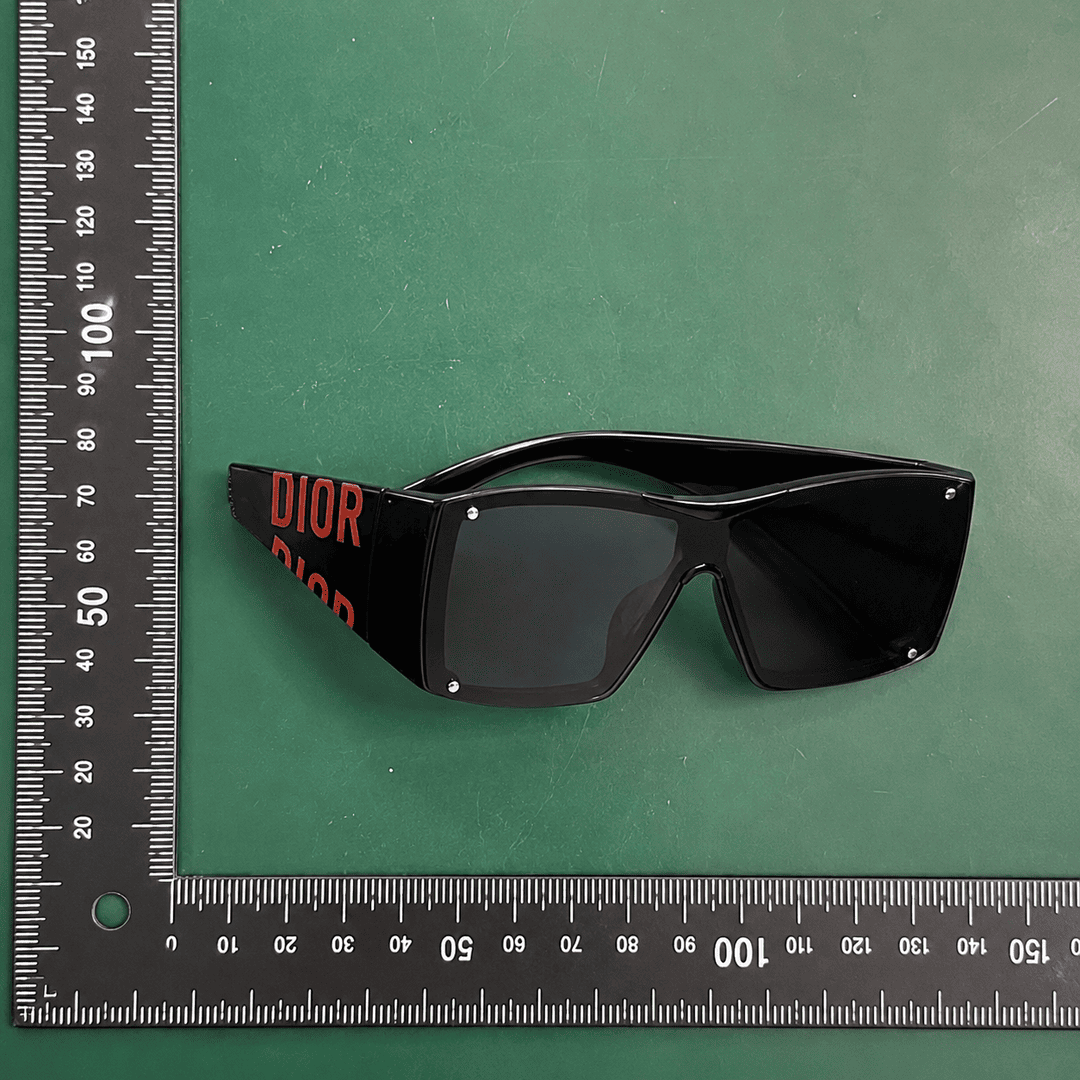
What This Dior Sunglasses QC Check Aims to Resolve
This article focuses on one specific item: Dior Black Sunglasses With a One-Piece Shield Lens and Oversized Coverage. The goal is not to authenticate the item or guarantee workmanship on the buyer's behalf, but to help you decide before ordering whether the existing QC photos are sufficient to support three decisions: whether to proceed with the purchase, whether to request additional photos, and whether to raise issues within the platform's allowed window.
The subject of this review is the View QC Photos gallery on the product detail page; the photos should match the style of this item. The review date is October 8, 2026; product price, stock, service fees, international shipping, and return/exchange terms remain subject to the shopping agent page you actually selected. 🕶️
The key risk with this item lies in the one-piece large lens, the wider coverage, and the temple connection areas. QC photos can help you spot surface and assembly concerns, but they cannot prove material, optical performance, wearing comfort, or brand authenticity.
Access the Product Detail Page and Confirm Style, Color and Specifications
First open the product detail page to confirm the product name, main image, and the currently selected style. Do not judge QC status from the brand page, category page, homepage, or images of other products.
The page records show this is a black, large-sized, one-piece shield lens design sunglasses. The product information emphasizes the overall silhouette and coverage, rather than the traditional two-lens structure. Before ordering, you should still confirm the actual dimensions of the lens, frame, and temples with the seller, especially the lens width, bridge width, and temple length. If the page does not provide complete numbers, you cannot substitute brand name or appearance ratio for dimensions.
It is recommended to have a pair of sunglasses you currently wear and find comfortable at hand, and compare the following items:
- Whether the lens width may cover too much facial area.
- Whether the temple length is sufficient and will not press against the temples.
- Whether the bridge position matches your face shape.
- Whether the black lens and black frame match your selected color, rather than mistaking light reflection for color change.
- Whether the style shown on the product page is consistent with the style in View QC Photos.
Obtain the Actual QC Original Photos for This Item via View QC Photos
After entering the product detail page, use the button labeled View QC Photos on the page to enter the QC gallery for this item. Do not guess the QC address based on URL structure, and do not treat the product main image, brand page images, or other product images as QC evidence.
The specified image for this item corresponds to Dior Black Sunglasses With a One-Piece Shield Lens and Oversized Coverage:

This image can only be used as corresponding evidence in the QC gallery for this item. When observing, first confirm whether the same one-piece lens, black frame, and large silhouette indeed appear in the image, then record details. What is visible in the photo is visible evidence; the purchase risk inferred from the photo is editorial judgment, and the two cannot be mixed into a product guarantee.
If the angles in the gallery are insufficient to clearly see both temples, the lens edges, and the hinges simultaneously, you should not write "no issues seen" as "confirmed no problems." In that case, the safer action is to request additional photos. 🔍
Which Lens Color, Edge and Surface Reflection Findings Are Visible Evidence
First check whether the lens color remains consistent at different angles. Black lenses showing reflections, local lightening, or environmental reflections under strong light do not automatically indicate fading or scratches. You need to compare multiple photos with similar angles to determine whether the change comes from lighting or from texture fixed on the lens surface.
Focus on the following visible items:
- Whether there is obvious and fixed difference in light/dark between the left and right areas of the lens.
- Whether the lens edges show chipping, nicks, burrs, or irregular cuts.
- Whether there are scratches, white spots, hazy areas, or residues that remain visible across multiple angles.
- Whether the fit between the one-piece lens and the frame shows obvious lifting, gaps, or uneven stress.
- Whether the reflections in the lens are only from the shooting environment or fixed shapes indicating surface damage.
Editorial judgment: Because the one-piece lens area is large, any anomaly located in the central line of sight, spanning a long distance, or near the edge structure is more worth requesting additional photos to confirm than ordinary small-area reflections. However, QC photos alone cannot determine lens material, transmittance, UV protection, or optical power, nor can they prove that the product meets any safety standard.
How to Record Frame Contour, Nose Pads and Left-Right Symmetry Item by Item
Check the frame as a whole first, then examine the left and right sides separately. Slight perspective distortion of the large silhouette may come from the shooting angle, so do not judge frame misalignment based on only one angled photo.
You can record in the following order:
- Observe the front view: whether the upper edge, lower edge, and outer contour of the frame are continuous, and whether the left and right heights are roughly consistent.
- Observe the angled side view: whether there is obvious misalignment or lifting at the junction of the lens and frame.
- Observe the nose pad area: whether there are cracks, missing parts, obvious shifts, or inconsistent left-right positions.
- Observe the temples in open state: whether the two temples are roughly in the same plane, or one side is obviously splayed or drooping.
- Compare with the product style: whether the one-piece lens and large coverage silhouette match the style selected on the detail page.
Here "symmetry" can only indicate the geometric relationship visible in the photos, not that wearing will necessarily be comfortable. The page information also suggests that for such large frames, you should compare with existing glasses according to lens, bridge, and temple dimensions, and cannot choose based solely on the Dior name. If the temples press behind the ears or on the temples, that is an adaptation issue to confirm before purchase, not something QC photos can solve for you. 📏
What Visible Details to Check on Hinges, Screws and Connection Points
Hinges are the position most likely to be missed in sunglasses QC due to insufficient angles. You should prioritize close-up photos of the connection between temples and frame to confirm whether the metal parts, screw heads, and connection seams are clearly visible.
Record when checking:
- Whether both left and right hinges are photographed, rather than only one side visible.
- Whether screws are clearly missing, crooked, protruding, or with surrounding cracking.
- When temples are open, whether there is obvious misalignment, gap, or extrusion marks at the connection.
- Whether the connection color between temples and frame shows abnormal peeling or large areas of discontinuity.
- Whether there are cracks, indentations, or residues near the hinges that affect opening and closing.
If the photos only show the exterior without opening angles, you cannot infer hinge tightness. QC photos cannot replace actual operational inspection, so do not write "looks neat" as "opens and closes normally." For parts needing additional photos, you can request the seller to provide close-ups of both hinges, fully extended temples, and lens edge close-ups.
How to Request Additional Photos When Angles Are Missing, Images Are Blurry, or Issues Are Found
After spotting a concern, first save the corresponding image and problem location, then make specific additional photo requests. Do not just send "please check quality," because that does not tell the seller what you need to confirm.
You can organize in the following format:
- Item: Dior Black Sunglasses With a One-Piece Shield Lens and Oversized Coverage.
- Location: left or right lens, frame edge, nose pad, left hinge or right hinge.
- Issue: scratches, edge chips, fixed reflections, gaps, screw condition, or left-right asymmetry.
- Required angles: front, left and right angled sides, fully extended temples, close-up of connection.
- Judgment criteria: want to clearly see the complete edge, screw head, and connection seam, not just an additional distant shot.
If the image is blurry, request a retake under natural or even lighting; if you suspect scratches on the lens surface, request changing the shooting angle to avoid reflection blockage; if you suspect hinge misalignment, request shooting both left and right sides simultaneously for comparison.
Whether to apply for processing should be based on the platform's rules for QC, returns/exchanges, or after-sales windows. Do not disassemble, bend, or try on and then attribute new damage to the seller. If the platform requires evidence submission within a specific time, you should first confirm the rules and required materials, then decide to keep, exchange, or refund. 🧾
Dior Sunglasses Review Checklist Before Ordering or Applying for Resolution
| Review Item | Existing Evidence and Next Action |
|---|---|
| Item correspondence | Confirm the detail page name, black one-piece lens, and large silhouette match View QC Photos; if inconsistent, pause ordering |
| Lens | Check color consistency, edge integrity, and fixed surface anomalies; if reflections cannot be judged, request multi-angle close-ups |
| Frame and nose pads | Compare left-right contours, nose pad positions, and fit; if angles insufficient, do not conclude flawless |
| Hinges and screws | Confirm both connection points, screws, and temple extension photos visible; request additional photos if missing |
| Dimensions and fit | Obtain lens, bridge, and temple numbers and compare with existing well-fitting glasses; do not purchase based solely on brand or appearance |
| After-sales decision | If clear defects, preserve original photos and apply within platform window; if insufficient evidence, request additional photos first, do not self-guarantee results |
Suitable to proceed with ordering are those who accept the appearance of the large one-piece lens and are willing to first verify dimensions, lens edges, and hinge photos. Not suitable for direct purchase include those who need clear lens material, optical performance, UV protection, brand authenticity guarantee, or cannot accept large facial coverage.
The final judgment should distinguish three things: whether the photos show an acceptable appearance, whether the dimensions are likely to fit you, and whether the product and platform provide the material, after-sales, and compliance information you need. QC photos can reduce visible risks, but cannot replace complete product information, actual wearing judgment, or platform after-sales rules.