Wide-foot buyers checking Jordan high-tops on fashion-reps need more than just "should I blindly go up half a size?" They need to confirm whether the toe box has lateral room, whether the upper compresses the instep, whether the collar design affects putting on and taking off, and whether the product page and QC photos actually provide verifiable size evidence.
This article is intended for buyers preparing to purchase Jordan high-tops but who only have size options and limited page images. After reading, you should be able to complete a pre-order evidence check and determine whether to request additional measurements from the seller. This article does not cover authentication, predicting actual fit, or replacing destination country return policy verification.
This article only discusses judgments supported by page-visible information, size charts, foot length data, and QC images. Content not shown on the page should not be written as confirmed facts. 🔍
Applicable Wide-Foot Sizing Tasks and Evidence Boundaries
The core task of wide-foot sizing is to match your foot length, foot width, and wearing preferences with the specific product's size chart and QC size evidence. The typical process can be divided into four steps:
- Measure the length and widest width of both feet, and use the larger foot as the initial baseline.
- Record your usual size in Jordan or similar shoes, but do not directly treat old shoe size as the new shoe conclusion.
- Check whether the product page provides a complete size chart, insole length, outsole length, or QC measurement photos.
- If width, collar, or upper compression cannot be confirmed from the page, request supplementary evidence before deciding to order.
As of October 8, 2026, the fashion-reps page sample checked in this article includes a brown Air Jordan 1 Low, with page display sizes ranging from 36–45, and shows product page, purchasing platform options, and QC photo entry. This page is a low-top model and cannot directly prove the collar height, upper coverage, or actual insole length of any Jordan high-top.
Therefore, the following judgments are divided into three categories:
- Can be directly confirmed from the page: size options, displayed measurements, and whether photos show insole or outsole measurements.
- Can be used as limited reference: common sizing experience for the same or similar shoe models.
- Cannot be confirmed from current evidence: true fit, width comfort, material elasticity, authenticity, and long-term deformation of this specific shoe.
Checking Jordan Product Page and Size Options on fashion-reps
When viewing a Jordan product on fashion-reps, first confirm that the page actually corresponds to the target shoe model, not just the word "Jordan" in the title. High-top, Mid, Low, and different generations may differ in collar, upper coverage, and internal space.
It is recommended to record page evidence in the following order:
- Product name: Confirm whether High, Mid, Low, or specific model is explicitly stated.
- Product images: Confirm that the images show the target shoe model, not other height versions of the same series.
- Size options: Record the available sizes and whether half sizes are included.
- Size chart: Confirm whether it is foot length, insole length, internal length, or just European sizes.
- Product description: Distinguish between information provided by the seller and platform editorial description.
- QC entry: Confirm whether actual measurements of this specific order or model can be seen.
- Purchasing platform: Before ordering, reconfirm the current fees, inventory, route, and after-sales conditions of the selected shopping agent.
The reference price displayed on the page cannot be directly equated to the final payment amount. Product price, service fees, international shipping, taxes, storage fees, and return/exchange costs need to be reconfirmed on the shopping agent page according to the destination country and package conditions. 👟
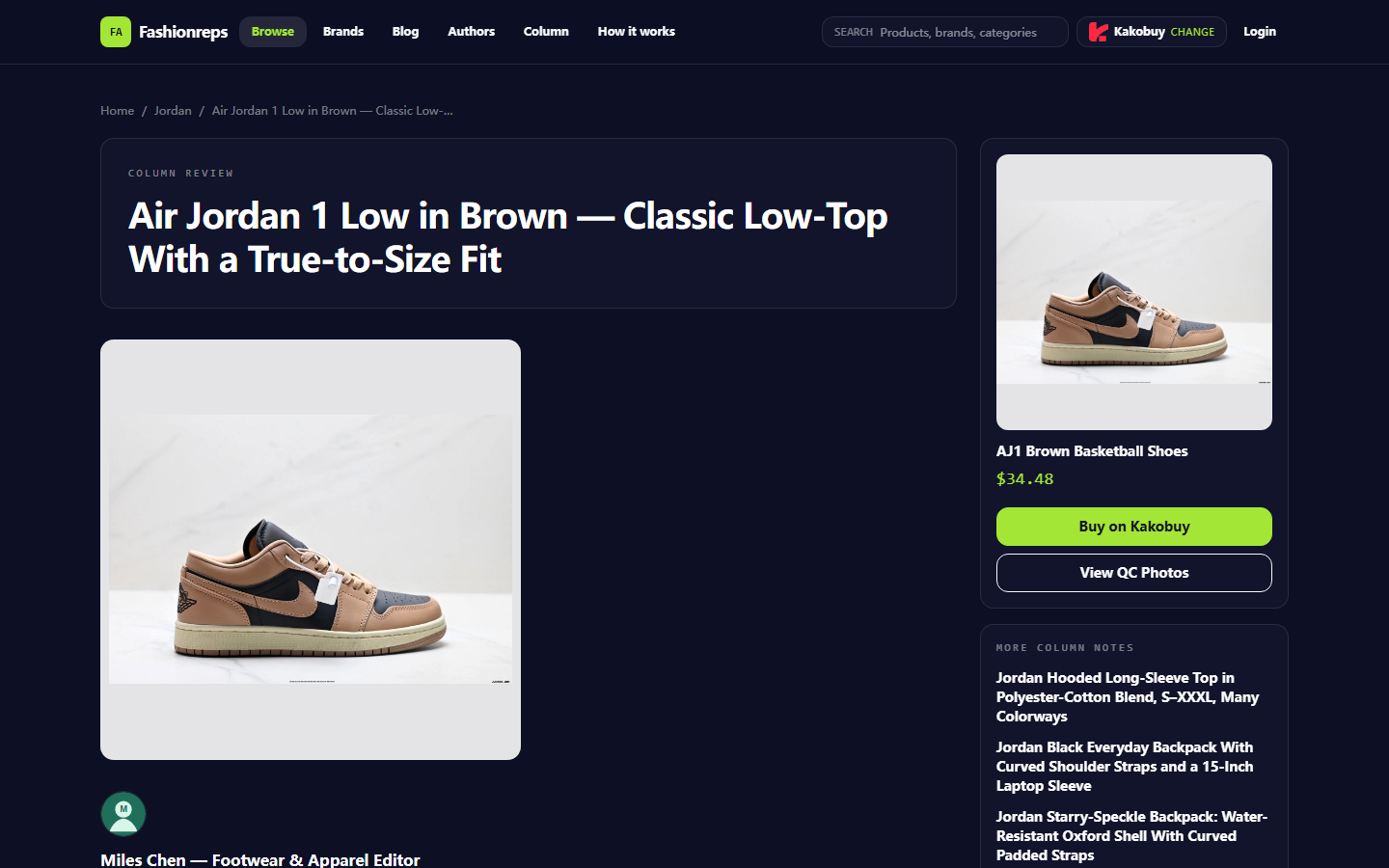
The representative page screenshot used in this article is shown below. It is from the fashion-reps Air Jordan 1 Low brown model page, only used to illustrate page information boundaries, and does not serve as size evidence for Jordan high-tops.

Figure: Size, product description, and QC entry information in the fashion-reps product page sample. This sample is a low-top model and cannot replace specific QC measurements for the target high-top.
How to Record Toe Room, Upper Coverage, and Collar Structure
Wide-foot buyers should not only ask "should I go up half a size?" but should break down the source of discomfort and record it separately.
Toe Room
When checking the toe box, focus on the following evidence:
- Is there a top-down photo at the widest part of the toe box?
- Does the upper significantly taper inward?
- Is there an insole length or internal length measurement in front of the toes?
- Is the toe box obstructed by stuffing, making it impossible to judge the width contour?
Insufficient toe length and insufficient toe width are two different problems. Increasing size may improve front-to-back space, but may not resolve lateral compression; at the same time, going up in size may reduce heel lockdown.
Upper Coverage
Jordan high-tops generally have more upper coverage than low-tops. Wide-foot buyers should check whether the widest part of the upper is restricted by laces, eyestays, or structural binding. If QC photos only show side views, they usually cannot confirm lateral space; top-down, frontal, or outsole contour photos are needed to assist judgment.
If the page only says "true to size" or similar general descriptions, this information can only be a starting point and cannot replace specific product width measurements. Especially when the page does not clearly state upper materials, internal structure, and measurement methods, it cannot be inferred that the fit is definitely loose or definitely requires sizing up.
Collar Structure
The collar of a high-top may affect ankle ease of entry and pressure. When checking, record:
- Can collar height be confirmed from side photos?
- Is collar padding noticeably thick?
- Does the collar have an inward tightening structure?
- Can laces cover and adjust to a wider instep area?
A tight collar does not mean a narrow toe box, and a wide toe box does not mean a comfortable collar. It is best to ask the seller about these two issues separately before ordering. 📝
How to Match Product Size Chart, Foot Length Data, and QC Sizes
The most important thing in size judgment is to confirm what is being measured. European size, foot length, insole length, and outsole outer length cannot be directly interchanged.
| Recorded item | Judgments supported | Judgments not directly supported |
|---|---|---|
| Foot length | Basic range for selecting size | Toe box lateral space and collar comfort |
| Foot width | Identifying wide-foot risk | Whether specific upper has enough allowance |
| Insole length | Estimating front-to-back space | Actual width at widest part of interior |
| Outsole outer length | Aiding comparison of external dimensions | Internal usable space and fit |
| QC top-down photo | Observing shoe silhouette and structure | Material elasticity, authenticity, and long-term durability |
| QC side photo | Observing height, collar, and upper coverage | Precise values of lateral space |
When actually checking, you can create a simple record:
- Left foot length: ____ mm
- Right foot length: ____ mm
- Left foot widest width: ____ mm
- Right foot widest width: ____ mm
- Usual shoe size: ____
- Target product size chart type: foot length / insole length / internal length / unspecified
- Target product QC has insole measurement: yes / no
- Target product QC has width measurement: yes / no
- Wear thick socks: yes / no
If the product size chart only has European sizes without foot length or internal length, the evidence level is low. In this case, you should prioritize requesting the seller to provide the insole length, widest width, and actual photos of the collar opening or structure for the target size.
Measurements also need to be consistent in method. Bent insole, uneven tape measure start, lens perspective, and shoe placement angle can all cause reading deviations. A single blurry QC photo should not be treated as a precise measurement result.
Image Gaps and Misjudgments Wide-Foot Buyers Need to Watch Out For
The following image gaps will significantly limit sizing judgment:
- No insole or internal length photo for the target size.
- No frontal or top-down photo, unable to observe toe box width.
- No close-up of collar, unable to judge padding and opening structure.
- Images only show promotional product photos, without specific order QC.
- Measurement units unclear, or ruler markings blocked.
- Left and right shoes, different shoes, and different sizes mixed in the same set of photos.
- Page title is high-top, but images actually correspond to low-top or other versions.
Also avoid several common misjudgments:
- Interpreting "wide size range" as "every size fits wide feet". Size range only indicates available sizes, not shoe width.
- Interpreting a wide-looking outsole as wide internal space. Outsole shape and internal usable space are not the same metric.
- Interpreting upper wrinkles as insufficient toe box width. Wrinkles may also be related to material, wearing style, lace tightness, and instep height.
- Directly applying low-top page experience to high-top. Collar and upper coverage differ, and evidence cannot be infinitely extrapolated across versions.
- Treating general editorial descriptions on the page as QC results for this specific product. Product-level evidence should prioritize actual photos of the target order or model.
The currently visible fashion-reps page sample mentions size and model-level fit information for Air Jordan 1 Low, but does not provide specific width, insole length, or collar measurements for the target Jordan high-top. Therefore, wide-foot high-top buyers still need supplementary product-level QC evidence.
What Outsole, Insole, and Internal Length Information Can Support
Outsole photos are suitable for observing external contour, outsole length proportion, and whether left and right shoes are roughly consistent, but cannot alone prove internal space. Insole photos are more valuable because they may provide measurable front-to-back length and widest width.
If you obtain insole measurements, it is recommended to also confirm:
- Whether the measurement is of the insole itself, or the visible length when placed inside the shoe.
- Whether the insole is fully removed and laid flat.
- Whether the measurement start and end points are clear.
- Whether width is measured at the widest point of the insole, or at a fixed position.
- Whether units are centimeters, millimeters, or inches.
Insole length greater than foot length does not automatically mean comfort. Instep height, toe shape, upper stiffness, and lace adjustment all affect fit. Outsole outer length cannot be converted to internal length, because the outsole includes edge structures, rubber wrapping, and design allowance.
For wide-foot buyers, the most useful evidence combination is typically "foot length vs insole length comparison" plus "widest width measurement" plus "frontal or top-down QC photo". When any one is missing, the conclusion should be downgraded to a preliminary judgment.
Fit and Authenticity Issues That Cannot Be Confirmed from Page Evidence
Even if product page images are clear, the following cannot be confirmed from images alone:
- Degree of toe compression after wearing for hours.
- Whether the upper becomes significantly softer with wear.
- Whether the collar rubs or compresses the ankle.
- Actual cushioning feedback of insole and outsole.
- Whether the product is authentic, replica, or from other sources.
- Whether materials exactly match the page description.
- Long-term deformation, sole separation, or durability.
These issues require stronger evidence, such as clear material descriptions, verifiable order QC, return/exchange conditions, or independent physical inspection. When the page does not provide them, they should be clearly marked as unknown, rather than replacing evidence with words like "comfortable", "authentic", "durable", or "guaranteed fit".
fashion-reps pages provide product discovery and purchase path information; final price, inventory, service fees, international shipping, and after-sales conditions still need to be reconfirmed on the selected shopping agent page. Before payment, also confirm destination country import restrictions, taxes, and declaration requirements, and comply with truthful declaration principles. 🚚
Pre-Order Size Verification Checklist and Next Actions
Before ordering, confirm item by item with this checklist:
- [] Product name clearly corresponds to Jordan high-top, Mid, or target specific model.
- [] Page images do not mix low-top, other generations, or other colorways as the target model.
- [] Your own left and right foot length and widest width have been recorded.
- [] Measurement object and units of the size chart have been confirmed.
- [] Insole length or internal length evidence for target size has been confirmed.
- [] Frontal, top-down, and collar QC photos have been checked.
- [] Product-level QC information has been distinguished from model-level general experience.
- [] Insufficient foot length, lateral compression, instep pressure, and tight collar have been considered separately.
- [] Current prices, inventory, service fees, route, and after-sales conditions of the shopping agent have been checked.
- [] Destination country taxes, import restrictions, and declaration requirements have been confirmed.
If currently only European size options and promotional images are available, without target size QC, the safest next step is not to directly go up half a size, but to request three supplementary materials from the seller: target size insole length, widest width, and clear actual photos of collar and toe box.
If supplementary materials still cannot be provided, this purchase should be regarded as a high-uncertainty choice. Wide-foot buyers especially should not order solely based on "I usually wear a certain size" or "someone says same series is normal". Only when your foot length, foot width, size chart, and QC sizes can form a traceable correspondence, the size judgment reaches an actionable level.
The conclusion is simple: current evidence can help you establish a sizing verification process for Jordan high-tops, but cannot confirm fit for the target high-top. When the page lacks width, insole length, and collar photos, choosing half size or full size is just speculation; requesting QC sizes first and then deciding whether to purchase is usually more reasonable than bearing return/exchange and international shipping risks afterward.