The Specific Problem This Article Solves for Patagonia Fall/Winter Jacket Shipping Costs
This article addresses a specific scenario: you're about to purchase a Patagonia fall/winter jacket you saw on fashion-reps, but before submitting an international package, you're unsure what components make up the final cost and how package size, chargeable weight, and destination conditions affect route selection.
After reading, you should be able to do three things: confirm the current product and quantity, record warehouse weighing and packaging information, and organize destination and route conditions before checking the final cost. This article does not apply if you already have a valid quote but need to handle customs disputes, returns, or package claims; those issues should be checked separately against the platform and carrier rules.

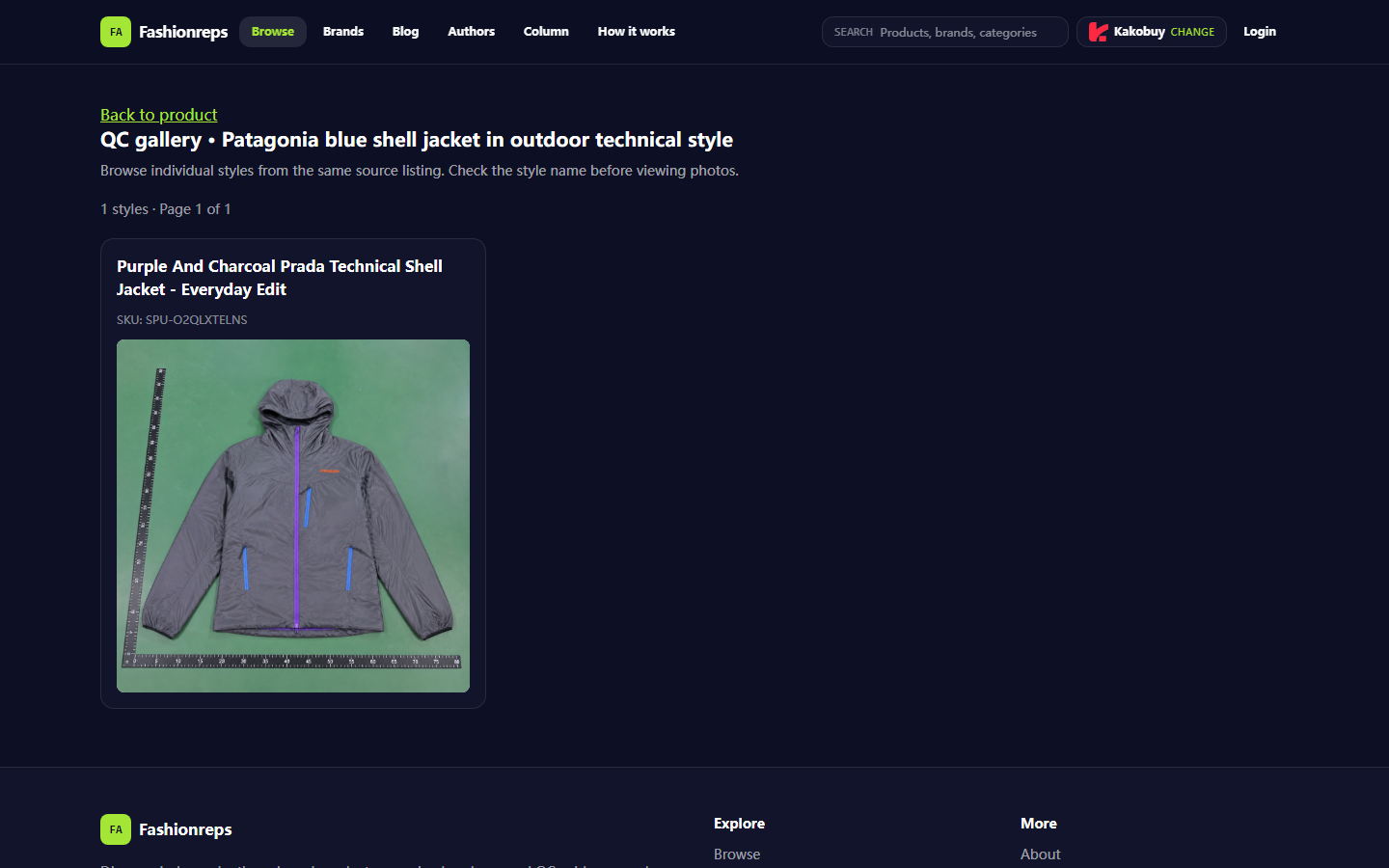
Image: Product page verification image used to identify the scenario discussed in this article. The image source is the fashion-reps on-site product page, publicly used for article scenario illustration.
Boundaries Between Page Facts, Calculator Results, and Editorial Judgment
This article only uses information that can be re-verified from the current page, warehouse records, or official calculators as the basis for costs. Images and pages can help identify the product scenario but cannot alone prove the jacket's actual weight, package dimensions, inventory, price, or available routes.
The current materials do not provide verifiable product transaction price, warehouse actual weight, package dimensions, destination, route quotes, or exchange rate results. Therefore, this article does not output specific amounts and does not package example numbers as current quotes. Costs must be based on the product page, account page, warehouse weighing records, and route calculator results on the day of inquiry.
Editorial judgment only serves to break down the verification method; it does not mean the editor personally purchased, received, wore, or tested the product. The page content is produced by an automated system and checked for factual boundaries against visible materials; readers should still verify on their own before payment or shipment submission.
First Confirm the Jacket Specifications, Quantity, and Current Visible Price
First, open the corresponding product page and confirm that the product name, color, size, quantity, and current visible price match the shopping cart. The brand name Patagonia itself cannot prove product authenticity, material, warmth performance, or after-sales eligibility, nor can it replace the specific records of the product page and purchasing platform.
Recommended information to save:
- Product name, color, size, and quantity shown on the product page
- Unit price and currency shown when adding to cart
- Stock or purchase availability shown on the page, and the verification date
- Whether the order includes other products
- Whether the purchasing platform charges additional service fees, payment fees, or domestic forwarding fees
If the product price, stock, or page status is not confirmed in the current inquiry, mark it as a pending item and do not fill it in with old screenshots or search summaries.
How to Verify Package Size, Packaging Method, and Chargeable Weight
For jackets, you typically need to pay attention to compressed volume, outer package dimensions, and whether it is consolidated with other products. Actual billing may take the higher of actual weight and volumetric weight, but the specific formula, divisor, minimum chargeable weight, and route restrictions must be based on the current calculator of the selected carrier or shopping agent, not rules from another route.
Request from the warehouse or record the following data:
- Actual weight before repackaging
- Length, width, and height after repackaging
- Calculation result of chargeable weight or volumetric weight
- Whether shoe boxes, hangers, extra packaging, or non-essential fillers were removed
- Quantity, category, and declaration information of all products in the package
Packaging adjustments are not purely cost-saving operations. Compression may reduce volume but may also increase the risk of wrinkling, crushing, or damage; removing original packaging may affect returns/exchanges, shipping protection, or subsequent verification. You must not hide products, falsify weight, or alter true declaration content to reduce costs.
How to Record Destination, Route, Currency, and Inquiry Time
The same jacket sent to different countries, regions, or postal codes may be subject to different routes, fuel surcharges, remote area rules, import restrictions, and tax arrangements. When checking costs, you should simultaneously record at least:
- Destination country, region, and necessary postal code
- Selected shipping route and service type
- Chargeable weight, package dimensions, and number of packages
- Quote currency, exchange rate source, and inquiry time
- Whether the quote includes fuel surcharge, remote area fee, insurance, taxes, or customs clearance service
- Quote validity period and conditions that may trigger re-billing
If the platform only shows a converted local currency amount without stating the exchange rate source or update time, keep the original quote currency and mark the converted result as an estimate. The final payment amount may also be affected by the card issuer's exchange rate and cross-border payment fees.
How to Establish Pending Items When Lacking Real-Time Cost Evidence
When there is no verifiable real-time cost evidence available, you can first create a cost breakdown sheet, but all unknown items must be left blank or clearly marked as pending; you must not fill in guessed amounts.
The cost breakdown should include:
- Product price: based on the currency and amount shown on the current product page or order page
- Shopping agent service fee: confirm whether it is charged based on product price, order amount, or other rules
- Payment fee: confirm whether the payment channel, cross-border card fee, or other handling fees are listed separately
- Warehouse handling fee: confirm whether inbound, inspection, repackaging, or outbound are charged
- Packaging fee: confirm whether packaging materials, compression, reinforcement, or removal of packaging are charged
- International shipping fee: re-query based on destination, route, chargeable weight, and dimensions
- Taxes and customs clearance fees: confirm who bears them, when they are collected, and whether there are import restrictions
- Exchange rate impact: keep the quoted currency and record the conversion time
If any key item lacks a source or inquiry time, you cannot present the total price as a confirmed result. You may continue preparing materials, but should postpone final route selection or payment confirmation. 🧾
Pre-Shipment Cost and Conditions Checklist
| Verification Item | Content That Must Be Confirmed | Current Handling |
|---|---|---|
| Product information | Name, color, size, quantity, current price, and currency | Re-verify with current product page and order page |
| Package information | Actual weight, dimensions, volumetric weight, packaging method | Await warehouse actual measurement records |
| Destination conditions | Country or region, postal code, prohibited/restricted items requirements | Re-query with delivery address |
| Route quote | Route, quote currency, inquiry time, validity period | Use current official or platform calculator |
| Additional fees | Service fee, payment fee, packaging fee, taxes, customs clearance fee | Confirm item by item whether included |
| Risk conditions | Re-billing, delays, damage, return, and claim limitations | Read current route terms |
When reviewing, do not just look at one total shown on the page. First confirm whether this total includes product price, service fee, payment fee, packaging fee, international shipping fee, taxes, and currency conversion; if the inclusion scope is unclear, require the platform to display by item or retain original details.
Final Action: Complete Verification Before Choosing Route or Postponing Shipment
After completing verification, first put product information, warehouse actual measurement data, destination, route, currency, and inquiry time in the same record, then compare available options. Consolidation may reduce duplicate first weight or fixed operating costs, but may also increase total volume, chargeable weight, package value, and one-time loss risk; splitting may increase fixed costs but may be more suitable for route restrictions, weight limits, or risk diversification.
Therefore, you cannot directly assert that consolidation is always cheaper without sample data. Only by comparing complete costs item by item for single and split packages under the same destination, same inquiry time, and same declaration conditions can you determine the savings. The final record should include: how much was saved, what risks were added, for which types of orders it is suitable, and under what conditions the approach is not recommended.
It is not recommended to submit shipment directly in the following situations: product specifications not yet confirmed, warehouse has no actual weight or dimensions, destination information incomplete, route quote expired, tax responsibility unclear, or platform cannot explain re-billing and claim conditions. In such cases, postponing shipment and completing evidence is usually more prudent than bearing subsequent costs based on an incomplete total. 📦